About
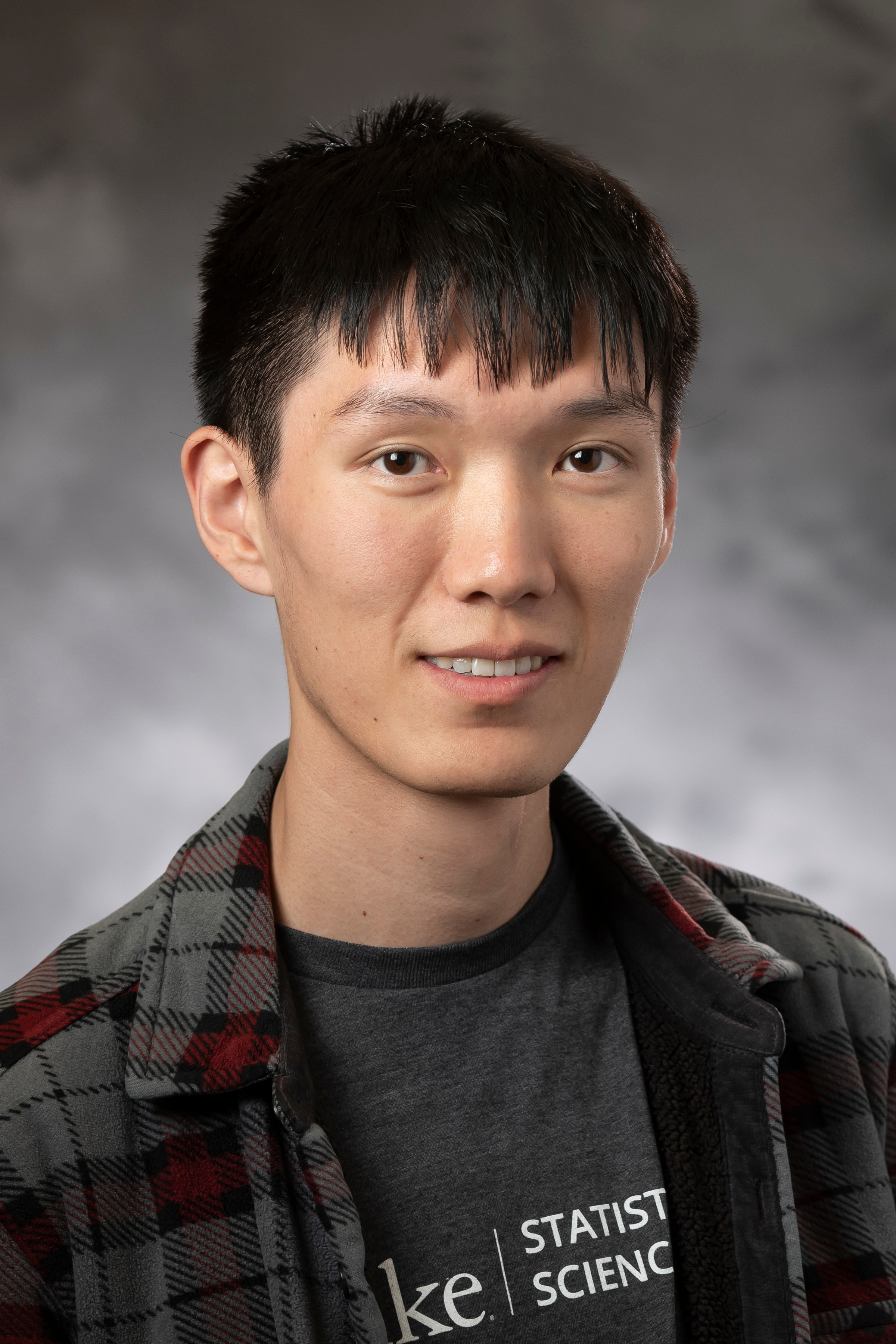
Jonathan Lin
I am a second-year PhD candidate in the Department of Statistical Science at Duke University, where I am advised by Professor Surya Tokdar. My interests lie broadly in the field of Bayesian statistics — in particular, with nonparametric density estimation, the predictive Bayes framework, and empirical Bayes. Within these fields I aim to develop novel statistical methods that are both practical and theoretically valid.
My most recent work deals with Newton's algorithm, otherwise known as predictive recursion. In its original formulation in 1998, predictive recursion arose as a result of pretending that a stream of data came from a sequence of nested Dirichlet process priors. Such an intuition is perfectly in line with the framework of predictive Bayes. Indeed, recent progress in the theory of martingale posteriors suggests that the success of predictive recursion may be fundamentally linked to a predictive interpretation of Bayesian statistics. I am interested in not only investigating the theoretical underpinnings of this relationship, but also in leveraging the predictive Bayes framework to gain practical advantages over standard Bayesian methodologies.
Before coming to Duke I double-majored in Statistics and English at UC Berkeley, where my statistical thinking was shaped by Sandrine Dudoit and Steven Evans. Outside of research, I write novels, short stories, and poetry. I also enjoy cooking.